
Bedford County Court of Common Pleas
Bedford County is Pennsylvania's 57th Judicial District. The Court of Common Pleas is the county's general trial court and hears major civil and criminal cases, along with family matters and other proceedings assigned to the Common Pleas level. The county lists President Judge Travis W. Livengood and Judge Brandi J. Hershey as the two Common Pleas judges. Court Administration is on the second floor of the Bedford County Courthouse, 200 South Juliana Street, Bedford, PA 15522, with phone 814-623-4812 and fax 814-623-3858.
The courthouse is more than a location marker. It houses Court Administration, the Court of Common Pleas, the Prothonotary, Clerk of Courts, Clerk of Orphans' Court, District Attorney, Public Defender, Sheriff, Domestic Relations, Probation, and Register/Recorder offices. That concentration shapes records access. A Common Pleas criminal docket may appear in UJS, but the certified record path runs through the Clerk of Courts. A civil or divorce file may be with the Prothonotary. Estate work may go through the Register of Wills and Orphans' Court path.
The county court department navigation shows how Bedford County groups Court of Common Pleas, court administration, clerk, sheriff, District Attorney, Public Defender, and Magisterial District Judge resources.
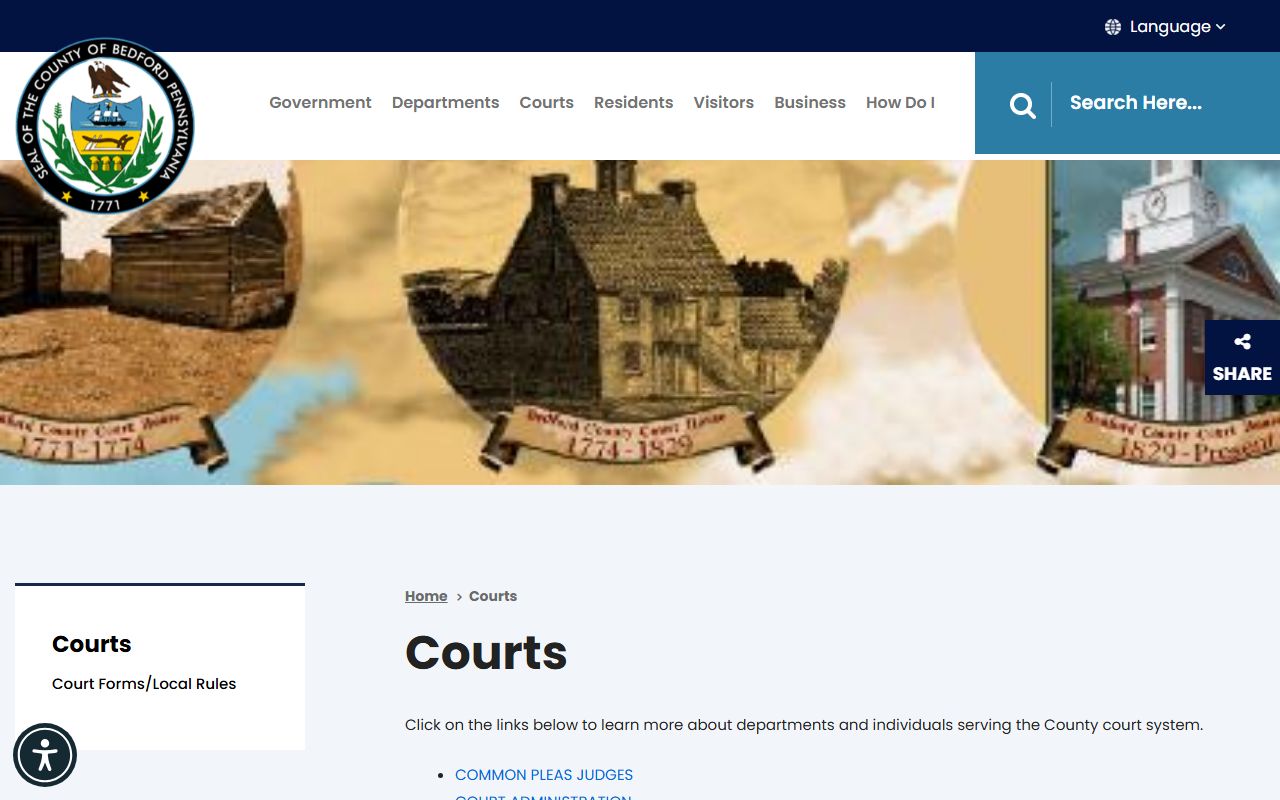
That department layout is useful because case records often require both the court level and the correct courthouse office.
Bedford County Court Directory
The Court of Common Pleas sits above Bedford County's Magisterial District Courts. Central Court also operates at the courthouse on Wednesdays for countywide preliminary hearings. The table below uses the county's court hierarchy research and includes the Common Pleas court, Central Court, and all four Magisterial District Court offices listed by the county.
| Court | Type | Address | Phone |
|---|---|---|---|
| Court of Common Pleas, 57th Judicial District | General trial court | 200 South Juliana Street, Bedford, PA 15522 | 814-623-4812 |
| Central Court 57-3-00 | Preliminary hearings | 200 South Juliana Street, Bedford, PA 15522 | Wednesdays: 814-624-2254 |
| MDJ 57-3-01, Judge Tonya Osman | Magisterial District Court | 1563 Market St, Schellsburg, PA 15559 | 814-733-4375 |
| MDJ 57-3-02, Judge Kevin R. Diehl | Magisterial District Court | 120 West John Street, Bedford, PA 15522 | 814-623-6918 |
| MDJ 57-3-03, Judge Brian Baker | Magisterial District Court | 124 Hitchens Road, PO Box 126, Defiance, PA 16633 | 814-390-6061 |
| MDJ 57-3-04 | Magisterial District Court | 119 Spring Lane, Everett, PA 15537 | 814-652-2523 |
Bedford County Common Pleas Judges
Bedford County's Common Pleas court page confirms the 57th Judicial District and lists its two Common Pleas judges. President Judge Travis W. Livengood and Judge Brandi J. Hershey handle the county's general trial court work. The research also notes Bedford County Treatment Court, with Pennsylvania Courts reporting a first graduation ceremony in 2025 overseen by President Judge Livengood. Detailed Treatment Court eligibility was not captured in official local pages, so eligibility should be confirmed through Court Administration, Probation, the District Attorney, defense counsel, or the Public Defender.
The 57th Judicial District judges page confirms the current Common Pleas judges and court administration contact.
Judge and court administration details help users separate court scheduling questions from clerk copy requests.
Common Pleas vs Magisterial Courts
Pennsylvania's court system places the Court of Common Pleas above minor courts, including Magisterial District Courts. Bedford County also uses Central Court for countywide preliminary hearings on Wednesdays. The practical question is where a case starts, where it is searched, and which office can provide copies.
| Topic | Court of Common Pleas | Magisterial District Courts | Central Court |
|---|---|---|---|
| Main role | Major civil and criminal trial court | Preliminary criminal, summary, traffic, landlord-tenant, smaller civil matters | Countywide preliminary hearings |
| Bedford search path | UJS for criminal dockets; Prothonotary or Clerk of Courts for files | UJS for many MDJ dockets; MDJ office for court-specific issues | Wednesday courthouse process and related docket contacts |
| Clerk path | Prothonotary for civil; Clerk of Courts for criminal | Specific MDJ office | Central Court at courthouse on Wednesdays |
| Examples | Felony criminal, divorce, custody, civil suits, judgments | Traffic citations, summary offenses, preliminary arraignments, landlord-tenant cases | Preliminary hearings after criminal charges |
Bedford County Case Flow
Case flow depends on the record type. A criminal case may begin with arrest or charges, move through an MDJ or Central Court preliminary stage, and then proceed to Common Pleas if held for court. Civil cases begin with a filing in the Prothonotary's office when they belong at Common Pleas level. Traffic and summary matters often remain with the Magisterial District Court unless a more serious criminal issue, such as DUI, moves into the criminal court track.
Criminal flow: Arrest or complaint › preliminary arraignment › MDJ or Central Court preliminary hearing › Common Pleas filing › arraignment › pretrial motions › plea or trial › disposition and sentence › appeal.
Civil flow: Complaint or petition filed with the Prothonotary › service and response › motions or conferences › hearing, trial, settlement, or order › judgment or final order › appeal where allowed.
Bedford County Central Court
Central Court is a distinct Bedford County operational detail. It occurs every Wednesday at the courthouse, starts at 9:00 a.m., and remains open until all cases are complete. Defendants report to the first floor and check in with the Public Defender's Office even when they are not represented by that office. Address changes should be provided at check-in. Victims and witnesses report to the double rooms on the second floor by the ramp and check in with Victim Advocate staff. Attorneys check in outside Courtroom No. 3 on the second floor.
Payment rules for Central Court are narrow. Defendants who pay during Central Court must bring exact cash. The county notes that no change is given and no other payment forms are accepted. This is different from some MDJ office payment windows, where cutoff times vary by office. If a case has a payment, warrant, or hearing issue, verify the issuing court and the exact payment rule before arriving.
Bedford County Court Records Access
UJS Case Search is the main public docket route for Bedford County criminal Common Pleas cases, Magisterial District Court matters, and appellate dockets. Public users can search by participant name, docket number, OTN, complaint number, incident number, citation number, date filed, and other fields depending on the search mode. UJS may show charges, events, dispositions, scheduled hearings, and financial obligations when public. It may not show recent entries right away, and it will not display juvenile, expunged, limited-access, or other protected cases.
For civil Common Pleas records, use the Prothonotary. For criminal Common Pleas certified copies, use the Clerk of Courts. For probate and estate matters, use the Register of Wills and Orphans' Court clerk path. For case types outside county court, federal filings use the Western District of Pennsylvania or federal bankruptcy court rather than the Bedford County courthouse offices.
The Pennsylvania court structure overview explains how the statewide courts, Courts of Common Pleas, and minor courts fit together.
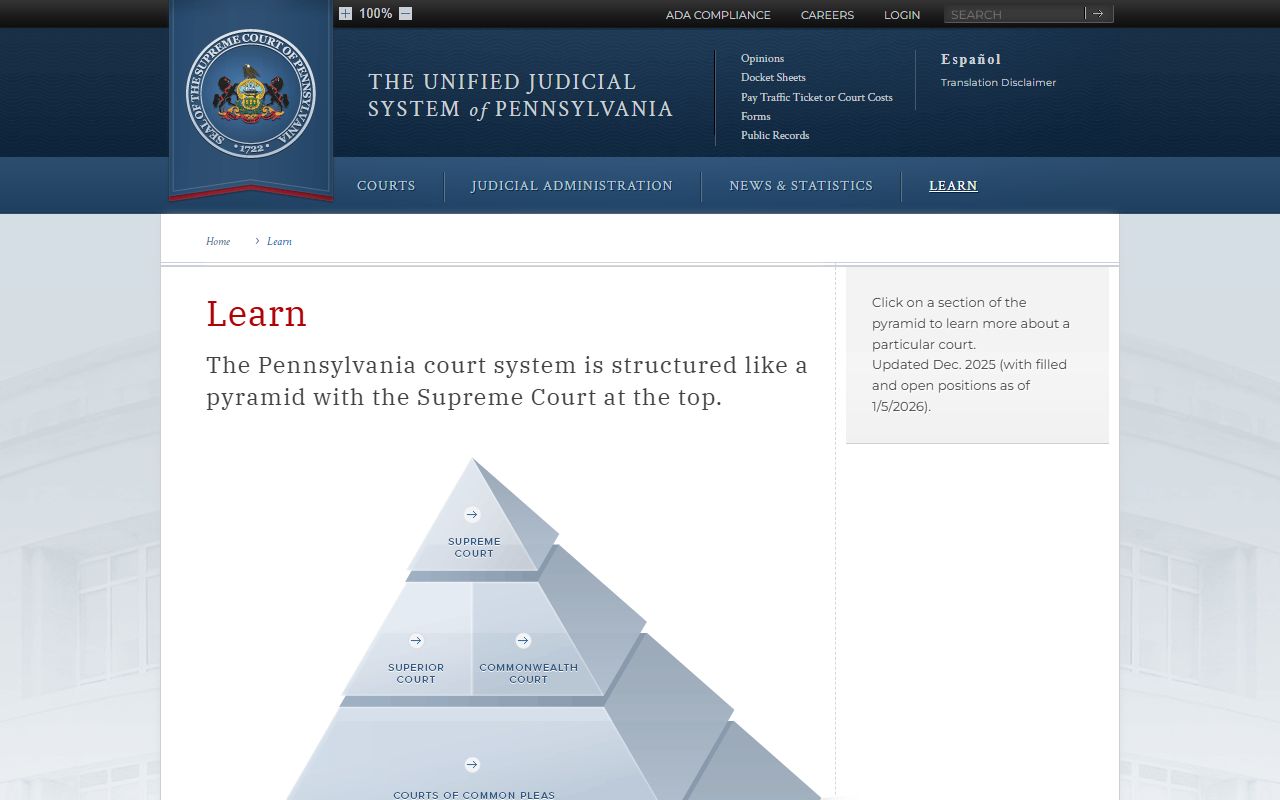
That statewide structure is the reason a Bedford County search may move from MDJ records to Common Pleas records and then to appellate courts.
Bedford County Courthouse History
Bedford County was established March 9, 1771 from Cumberland County. The current courthouse's original section dates to 1828 or 1829, and county materials describe it as the second-oldest Pennsylvania courthouse still in continuous use. Earlier courts met in a log structure at the Square, followed by a stone courthouse built in 1774. The current Greek Revival red-brick courthouse was designed by local architect Solomon Filler and includes a dome-topped bell tower, Doric columns, Flemish Bond brickwork, and a circular foyer with twin unsupported staircases.
The courthouse history matters to record users because the building has long housed original papers. The 1876 addition created heavy room-sized safes over limestone barrel vaults for records such as wills, deeds, and estate files. A later addition changed access to hidden basement record vault areas. For older Bedford County Court of Common Pleas records, the courthouse is not just a hearing site. It is part of the county's records archive.
Bedford County's judge history also reaches back to Thomas Smith, who served in early county record offices before becoming a judge. The research notes that he was appointed Prothonotary, Clerk, and Recorder in 1773 and Deputy Register of Wills in 1773. That history helps explain why older court, clerk, land, and estate records can overlap in local archives. Modern users should still start with the current office responsible for the record type.
Recent court activity keeps the courthouse relevant as a working court, not only a historic site. Pennsylvania Courts reported a Superior Court visit to Bedford County's historic courthouse in 2024, and local materials note security improvements made while preserving the building's character. Users attending hearings should confirm current access rules with Court Administration, especially for jury duty, scheduled hearings, or court-day questions.